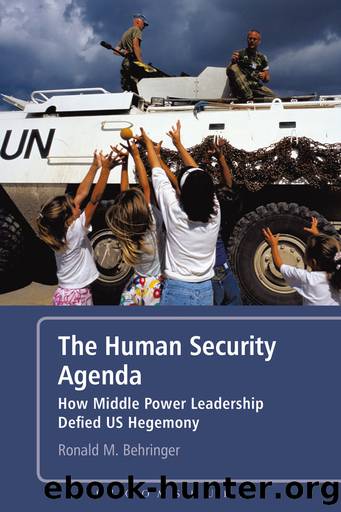
The Human Security Agenda: How Middle Power Leadership Defied U.S. Hegemony by Ronald M. Behringer
Author:Ronald M. Behringer [Behringer, Ronald M.]
Language: eng
Format: epub
Tags: International Relations, Globalization, Political Science, General
ISBN: 9781441176479
Google: x1O99Cj8z08C
Goodreads: 23071492
Publisher: Not Avail
Published: 2012-09-01T00:00:00+00:00
Conclusion
The initiative to create an ICC demonstrates that middle powers are capable of skilled leadership on issues of human security. The middle powers brokered the strong and cohesive LMG, an amazing task in that the coalition included nearly one-third of all the countries in the world. Middle power officials assumed influential positions at the meetings of the Preparatory Committee and at the Rome Conference, which enabled them to control the negotiations on the ICC. Adriaan Bos from the Netherlands and Philippe Kirsch from Canada were astute chairmen, especially in their appointment of middle power delegates as issue coordinators. The LMG cultivated a close relationship with the CICC, thus forming a powerful, pro-ICC lobby at the Rome Conference. Most important, the LMG held firm when the United States and other members of the P5 sought to weaken certain provisions of the Rome Statute.
The Clinton administration was in favor of an ICC, as long as the United States was exempt from its jurisdiction. At the Rome Conference, the United States pushed unsuccessfully for UN Security Council oversight of the ICC, so that the United States would be able to veto any ICC investigation which conflicts with American interests. The Clinton administration was concerned that a fully independent ICC would conduct politically motivated trials of US military personnel without regard for their constitutional rights as American citizens. Although the United States tried to thwart the adoption of the Rome Statute, skilled diplomacy by the LMG managed to sidestep American opposition and established an ICC with a Prosecutor who can initiate investigations proprio motu.
President Clinton finally signed the Rome Statute in 2000 in order to give the United States a voice in the further development of the ICC, but President Bush withdrew the United States from the statute seventeen months later. It was not until the War in Iraq, and the ICC Prosecutorâs decision that the numerous allegations of war crimes committed by the US-led coalition were inadmissible, that the Bush administration began to view the ICC as less of a threat to core American interests. The Obama administration has embarked on a wise policy of positive engagement with the ICC, which hopefully will lead to closer relations, and perhaps ICC membership, in the near future.
Download
This site does not store any files on its server. We only index and link to content provided by other sites. Please contact the content providers to delete copyright contents if any and email us, we'll remove relevant links or contents immediately.
The Secret History by Donna Tartt(19088)
The Social Justice Warrior Handbook by Lisa De Pasquale(12190)
Thirteen Reasons Why by Jay Asher(8910)
This Is How You Lose Her by Junot Diaz(6887)
Weapons of Math Destruction by Cathy O'Neil(6280)
Zero to One by Peter Thiel(5802)
Beartown by Fredrik Backman(5754)
The Myth of the Strong Leader by Archie Brown(5507)
The Fire Next Time by James Baldwin(5446)
How Democracies Die by Steven Levitsky & Daniel Ziblatt(5218)
Promise Me, Dad by Joe Biden(5153)
Stone's Rules by Roger Stone(5088)
A Higher Loyalty: Truth, Lies, and Leadership by James Comey(4964)
100 Deadly Skills by Clint Emerson(4925)
Rise and Kill First by Ronen Bergman(4789)
Secrecy World by Jake Bernstein(4753)
The David Icke Guide to the Global Conspiracy (and how to end it) by David Icke(4719)
The Farm by Tom Rob Smith(4511)
The Doomsday Machine by Daniel Ellsberg(4490)
